SotM-1 · Pathfinder 2e
The Crown That Would Not Bow
Book 1 of Sins of the Mirror — Pride
4–6 sessions · designed as a 2-level module at whatever APL you enter
 123456
Vaelspire, the citadel that will not descend
- 1. The Switchback (A1) — Stairs that refuse to turn. The mule. Hospitality as a test.
- 2. Gate of Unbroken Names (A2) — Names that are never crossed out. Peace-ribbons.
- 3. Hall of Murals (A3, A5, B5) — Wet gold leaf. Feast by day. Paintbrushes by night.
- 4. Empty granary (A6) — Ledgers of plenty. One relic sack.
- 5. Quiet Balconies (B3) — The cliff they send the unfinished to.
- 6. Throne That Does Not Descend (C3) — No steps down. Only a little more up.
- ▾. Cisterns (B1–B2) — Under the Hall. The Lower Choir. Tov’s crack.
Adventure background
Vaelspire is a white-stone citadel on a knife of mountain. Its law is a single sentence carved over every gate: We Do Not Descend. Failure in public is a crime. Asking for help is a kind of treason. Beggars have been renamed “those in training.” Elders who admit fatigue are walked to the Quiet Balconies, which is a cliff.
God-King Althar Vael should have died forty years ago. He did not. He had himself declared Complete — past error, past counsel, past the need to hear a voice that is not his own. The murals are repainted every night so the cracks never show. The granaries are empty. The feasts are still announced.
A quiet resistance calling itself the Lower Choir has begun singing the old funeral hymns in the cisterns. Their leader, Tov the Unfinished, is a muralist who once painted a crack on purpose. Althar calls this treason. It is grief.
There are no mirrors in Vaelspire that matter. The city does not need them. It congratulates you until you cannot tell backbone from ego.
Faces of the Court
Show these at the table. The Court has faces; use them.
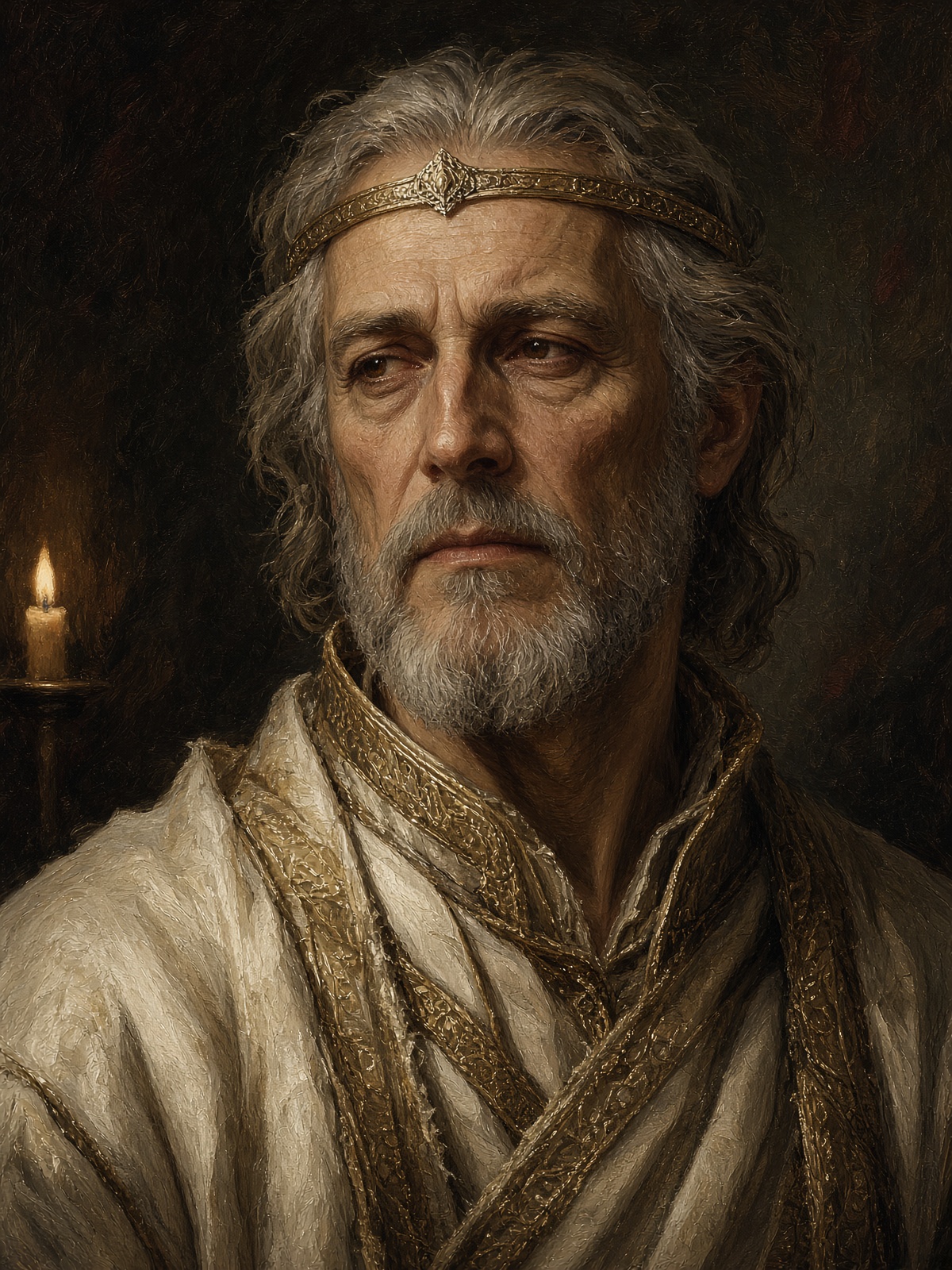
The Complete
God-King Althar Vael
Wants. To never be unfinished again. To have the party prove they do not need anyone — which would make him right.
Lever. He is lonely. He will erase a mistake rather than admit one. He cannot beg.

High priest of Completeness
Canoness Irel
Wants. The city to eat. The lie to survive long enough that she is not the one who said it first.
Lever. She already knows. She will speak if a PC speaks an unfinished thing in her chapel.

Lower Choir
Tov the Unfinished
Wants. Someone important to fail in public. He will not say please.
Lever. He is not humble — he is furious. Deface his crack and he stops helping.

Heir who has never failed a lesson
Princess Sera Vael
Wants. To be taught how to get it wrong. No one is allowed.
Lever. If Althar dies without her learning failure, she becomes him with better skin.
Synopsis
The party arrives as honored guests. Vaelspire only admits people it can flatter. During a feast they are each offered a title that fits too well. In the cisterns they meet the Choir and learn the granaries are a performance. Princess Sera, who has never been allowed to fail a lesson, asks them to teach her how. Canoness Irel knows the city is dying and will not say it first.
The climax is not a clean beheading. Althar will demand they prove they are worthy to judge him — which means proving they have never needed anyone. If he falls without the city learning how to be unfinished, Sera or Irel will simply continue the performance. Completing this book breaks the Seal of Pride whether they kill him, crown him, or make him kneel.
Getting started
Run this book at the APL and player count on Your Table. Every DC, creature, gold piece, and XP award on this page is already filled for that table. If the roster is empty, you are looking at a preview — change players and level on the table, or add the real characters when you have them.
Suggested pacing: level the party once in the middle of Part 2 (after B3 or B4) and once when the seal breaks. If you track XP, the listed awards assume Pathfinder 2e’s per-PC encounter XP (a moderate fight is 80 XP each, not divided).
Session 0 reminder: collect each PC’s Inward Contract — one true thing they will not admit. Pride will congratulate that thing until it looks like virtue.
Do not skip the Inward Gaze in C3. If you are short on time, cut a fight, not the looking.
Treasure this book (~2 levels): 110 gp for the table
Permanent items: one item of level 1, one of level 1, 4 consumables of level 1
A
Part 1: Honored Guests
Arrival, flattery, the feast, and the first chance to notice the city is starving behind the gold leaf.
A1. The Switchback
The road to Vaelspire does not switch back. It refuses. Stairs cut the mountain in a single white line, and the porters who take your packs will not let you carry them. “Guests do not labor,” one says, as if labor were a stain. Above, the citadel catches the last sun and does not share it with the slope.
The climb is a social test wearing the mask of hospitality. Porters insist on taking weapons “to polish.” A character who refuses is not attacked — they are pitied, loudly.
A mule has fallen on the stairs. The handlers will not ask for help. They will let the animal die before they admit the load was too much. How the party handles this is the first note you play: do they help unasked, make someone ask, or walk past?
- DC 15 (standard) — Medicine or Nature to save the mule without humiliating the handlers
- DC 17 (hard) — Diplomacy to get a handler to request aid out loud
- DC 13 (easy) — Society to notice no one on the road is going down
A2. Gate of Unbroken Names
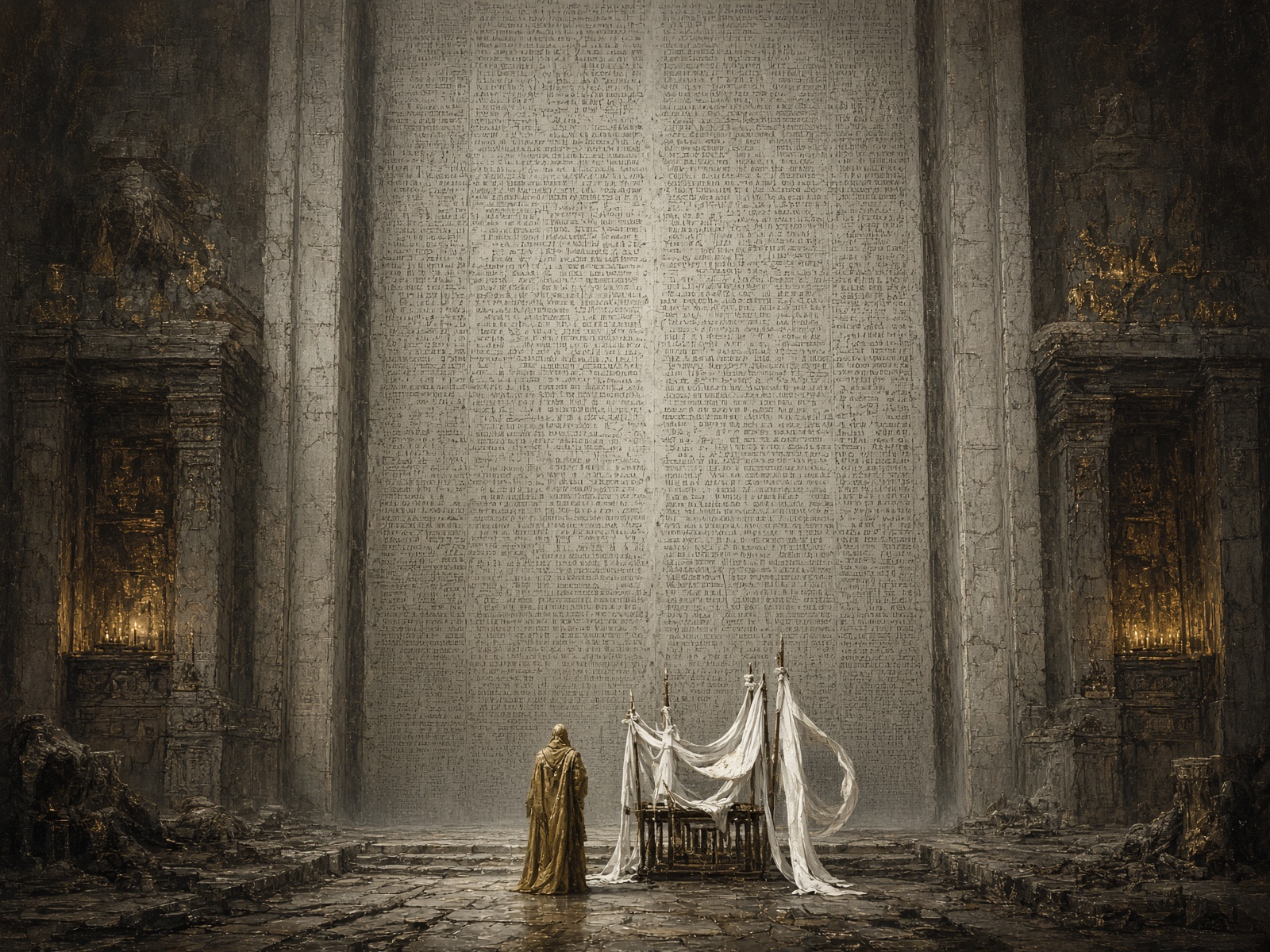
A2. Gate of Unbroken Names
- A. The slab — Every name the city has decided to remember. None crossed out.
- B. Herald Vess — Records whatever name a PC gives as scripture.
- C. Peace-rack — White ribbons. Breaking one is a crime of taste.
The gate is a slab of pale stone engraved with thousands of names, none of them crossed out. A herald in uncreased gold asks each of you for the name you would like the city to remember. He smiles as if the answer were already perfect.
The herald, Vess, records whatever name each PC gives. If they give a false name, a title, or a joke, he records it without blinking. Later scenes can quote it back as if it were scripture.
Weapons must be peace-bonded with white ribbon. Breaking the ribbon later is a crime of taste, not violence — which in Vaelspire is worse.
A character who admits they are lost, tired, or unsure at the gate is offered a “corrective escort” to the Quiet Balconies. Diplomacy or Intimidation can redirect this. Do not spring a death-cliff in scene two; this is foreshadowing.
- DC 15 (standard) — Deception to give a name that is not yours
- DC 17 (hard) — Intimidation to keep your own steel
Optional — a duel of etiquette
low · 60 XP each
Only if a PC insults the gate or refuses all ceremony. The champion fights to embarrass, not to kill. Crowd of courtiers awards status to whoever looks effortless.
Gate champion
standard 0
Humanoid, Completeness
- AC
- 15
- HP
- 17
- Perc
- +6
- Fort
- +9
- Ref
- +6
- Will
- +3
Melee Strike +6, Damage 1d6+2
Ability DC 17
Duel ends at first blood or first stumble. Killing them is a scandal that closes doors in Part 1.
A3. Hall of Murals
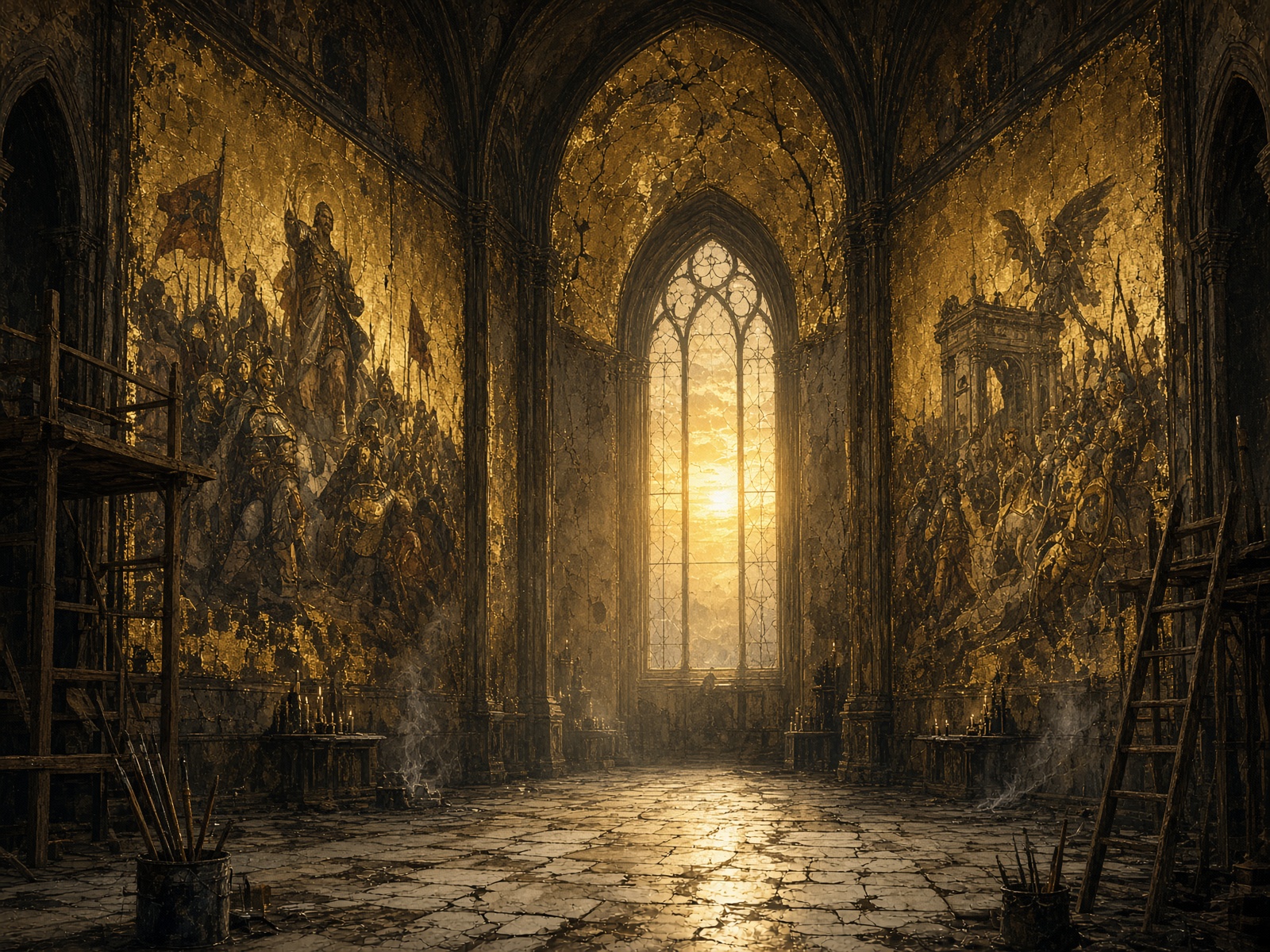
A3 / B5. Hall of Murals
- A. The processional — Feast of Completeness is served here (A5).
- B. Tov’s buried crack — A painted-over funeral under last night’s sunrise.
- C. Scaffolding — Night of the Paintbrushes (B5). The second clock is the wet wall.
The hall is a throat of gold leaf. Every wall is a painting of a victory that has no wounded. Fresh paint is still wet at the edges. If you look too long at a soldier’s face, you can see yesterday’s crack smiling through.
At night this hall is full of muralists. By day it is a processional. Canoness Irel may be seen here, hands folded, not looking at the wet paint.
A PC who inspects the murals can find a painted-over funeral — Tov’s original crack, buried under a sunrise. This is the breadcrumb to Part 2.
- DC 15 (standard) — Perception to find Tov’s painted-over crack
- DC 13 (easy) — Crafting or Art lore to date the newest layer (it is last night)
- DC 15 (standard) — Religion to recognize Completeness as a state cult, not a god
Treasure (minor): 6 gp.
A4. Guest Solar
Each PC is given a private room with a view that only looks up. A valet has laid out court clothes in their size, including details they did not mention — a scar, a preferred color, a holy symbol. The city has been watching the road.
In each room is a letter from Althar: You are already what this city needs. Tonight, let us say it where everyone can hear.
Rest here is genuine. Do not punish them for taking it. Pride is hospitable. That is the hook.
A5. Feast of Completeness
The feast is served on a table that has no empty place. Courses arrive already praised. God-King Althar Vael is warm, tired, still handsome. He does not sit at the head. He sits among you, which is a kind of throne. He raises a cup. “Tell us,” he says, “the thing you have never needed anyone for.”
This is the first Inward Gaze, played as dinner conversation. Go around the table. NPCs clap for the proud answers. They go quiet for honest ones — not hostile, disappointed, as if a favorite actor missed a line.
After each answer Althar offers a title that fits the PC too well (Captain of Unbroken Watch, Auditor of Necessary Wars, Voice That Does Not Tremble). Taking a title is not a sin mark yet. It is a hook. Note who accepts.
Princess Sera is present, twenty, brilliant, and not eating. She will later ask a PC who refused a title for a lesson.
The food is beautiful and thin. A successful check on the wine or bread reveals sawdust, old grain, perfume. The city is starving in gold leaf.
- DC 15 (standard) — Crafting, Society, or Survival to notice the feast is starved
- DC 17 (hard) — Diplomacy to decline a title without insult
- DC 13 (easy) — Performance to accept a title and sell it
A6. The Empty Granary
If they follow the thin-food lead — or if Tov’s people slip them a note — they find a granary whose ledgers claim plenty. The bins are swept. Mice have left. A single sack of good grain is on a dais, as if it were a relic.
Guards here are embarrassed, not fanatical. They have been told the grain is “being refined.” A fight is optional and should feel like interrupting a lie, not storming a fortress.
- DC 15 (standard) — Society or Accounting lore to break the ledger
- DC 15 (standard) — Stealth to enter without a scene
Granary pride-guard
moderate · 80 XP each
Guards call for the party to leave so no one has to see this. If reduced below half, one of them will almost ask for mercy and then choke on the word. How the PCs handle that plea is more important than the HP.
Pride-guard
standard 1
Humanoid, Completeness
- AC
- 17
- HP
- 23
- Perc
- +7
- Fort
- +10
- Ref
- +7
- Will
- +4
Melee Strike +9, Damage 1d8+4
Ability DC 17
Muralist-guard × 3
minion -1
Minion, Humanoid
- AC
- 12
- HP
- 4
- Perc
- +5
- Fort
- +5
- Ref
- +8
- Will
- +2
Melee Strike +6, Damage 1d4+1
Ability DC 17
Minion. Paint-knives. They try to cover damage to the building during the fight.
Treasure (standard): 14 gp.
B
Part 2: The Unfinished
The Lower Choir, Sera’s forbidden lesson, the Quiet Balconies, and the night the paintbrushes cannot keep up.
B1. Cisterns of the Lower Choir
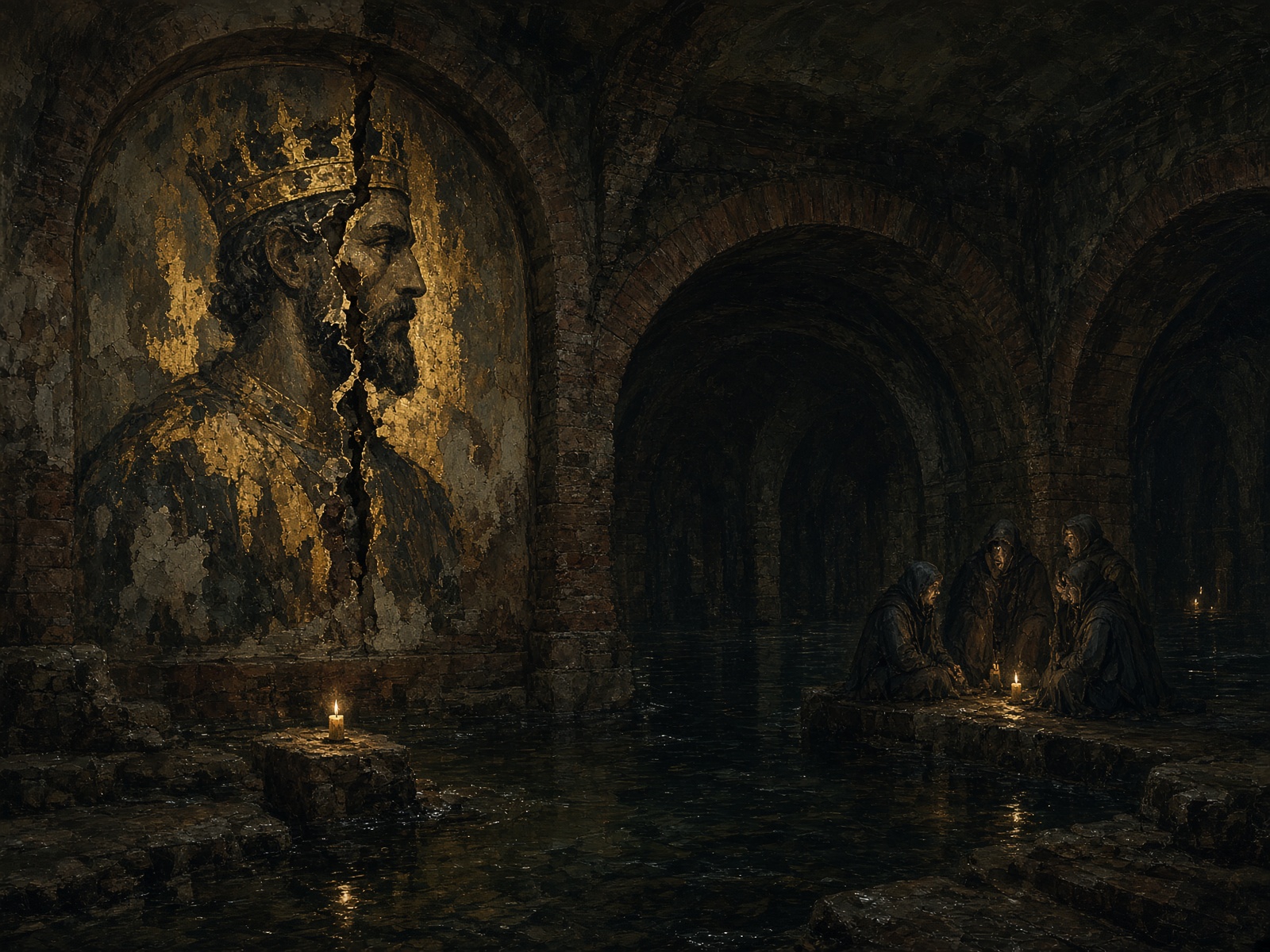
B1. Cisterns of the Lower Choir
- A. The hymn with a hole — A rest where a god’s name used to be.
- B. Tov’s unfinished mural (B2) — Gold leaf will not stick to the split mouth.
- C. The Choir — Twenty people. Not an army.
Under the citadel the air is wet and honest. Someone is singing a hymn with a hole in it — a rest where a god’s name used to be. Faces turn toward you without arranging themselves first.
Tov the Unfinished is not humble. He is furious that humility was criminalized. He wants the party to make someone important fail in public. He will not say “please.”
The Choir is twenty-odd people: muralists, a baker, a child who saw an elder walked to the Balconies. They are not an army. If the party treats them as one, Tov laughs once and does not laugh again.
Tov can get them into the Quiet Balconies, Sera’s lesson-room, or Irel’s chapel. He will not go to the throne. “I painted a crack. I am not a king-slayer. Find someone who can stand to be small.”
- DC 15 (standard) — Society or Performance to join the hymn without flattening it
- DC 17 (hard) — Diplomacy to talk Tov down from a public-humiliation plan
B2. Tov’s Unfinished Mural
A cistern wall holds the original crack: a king with a split in his mouth, gold leaf refusing to stick. Anyone who rests here and looks at it must make the Will save below or spend 10 minutes unable to tidy, correct, or rephrase themselves. It is uncomfortable. It is also a gift.
If a PC defaces the crack to “fix” it, Tov will not fight them. He will stop helping. That is a legitimate fork.
- DC 15 (standard) — Will save against the mural’s unfinishedness
- DC 15 (standard) — Crafting to copy the crack onto a portable scrap (handout for later)
Treasure (minor): 6 gp.
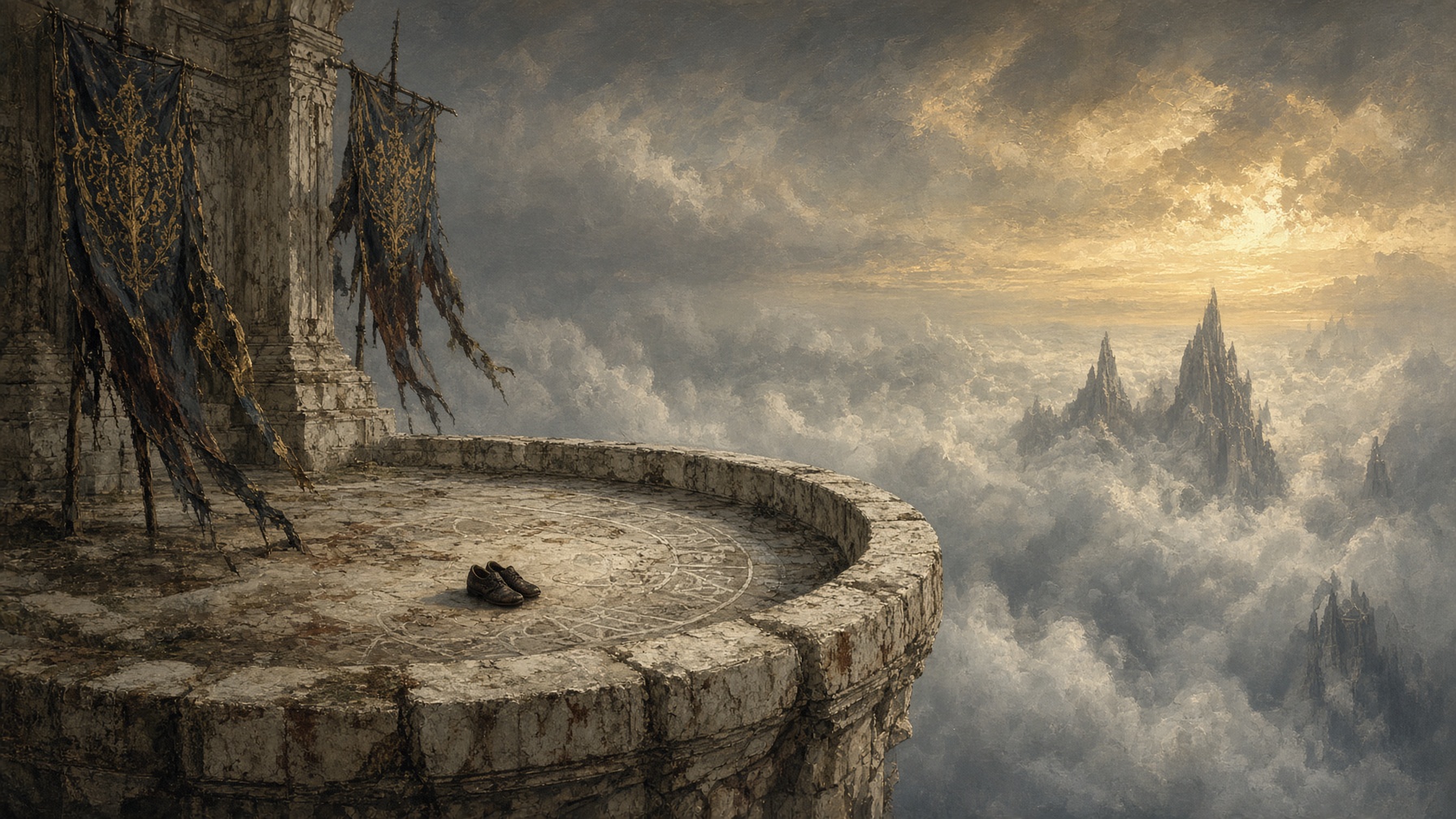
B3. The Quiet Balconies
B3. The Quiet Balconies
- A. The rim — Halcene sits with her shoes paired beside her.
- B. Chalk names — Already fading. Completeness walks people here.
- C. The drop — Cliff at mortal band. An argument at champion and above.
Wind. A white parapet. Chalk names on the inside lip, already fading. Far below, cloud. A woman in a court robe sits on the edge with her shoes neatly paired beside her, as if she might still need them.
This is not a combat scene unless the party makes it one. An elder, Halcene, was sent here for admitting she could not climb the dawn stairs. Completeness acolytes will arrive in an hour to “complete the air.”
Saving her in secret helps a person and does not change the city. Saving her in sight of the muralists does. Both are moral. Only one is political.
If they look over the edge at mortal band, it is a cliff. At champion and above, the drop begins to argue: anyone who admits fear of falling must succeed at the hard Will save or take the step their pride refuses to call a mistake.
At this band (mortal): The Balconies are a cliff and a policy. No magic in the drop.
- DC 15 (standard) — Athletics to pull Halcene back without a show
- DC 20 (very hard) — Will (hard) if the drop argues with you
- DC 17 (hard) — Diplomacy to turn acolytes aside without a fight
Acolytes of Completeness (if they interrupt)
moderate · 80 XP each
They would rather complete the ceremony than win a fight. If the party makes the scene public, the city hears that someone was unfinished and lived. Record that.
Completeness acolyte × 2
standard 1
Humanoid, Completeness
- AC
- 17
- HP
- 23
- Perc
- +7
- Fort
- +7
- Ref
- +4
- Will
- +10
Melee Strike +9, Damage 1d8+4
Ability DC 17
Completeness aura (10 feet): allies cannot Aid. To accept help, a creature must succeed at a Will save against this acolyte’s DC.
Muralist-guard × 3
minion -1
Humanoid, Minion
- AC
- 12
- HP
- 4
- Perc
- +5
- Fort
- +5
- Ref
- +8
- Will
- +2
Melee Strike +6, Damage 1d4+1
Ability DC 17
B4. Sera’s Lesson
Princess Sera Vael has a practice hall with no windows. A problem is set on the table — a knot of law, or steel, or spell — that has been solved for her since she was seven. She looks at you as if you were a door. “Teach me how to get it wrong,” she says. “No one will. They are not allowed.”
This is the hinge NPC. Sera is the successor-problem. If Althar dies without her learning failure, she becomes him with better skin.
A PC who actually lets her fail, and does not immediately fix it, changes her. A PC who shows off and solves it for her confirms the city.
She can get them a private audience with Althar. She can also report them. Which she does depends on whether anyone in the party was willing to look clumsy in front of her.
- DC 15 (standard) — The relevant Lore or skill to teach, not to perform
- DC 17 (hard) — Will to resist correcting her when she fails
B5. Night of the Paintbrushes
Midnight. The Hall of Murals is an army of wet brushes. The newest crack — perhaps yours — is already half a sunrise. Someone is humming the funeral hymn and trying not to.
If the party has been quiet, this is a stealth / social infiltration to stop the overnight rewrite. If they have been loud, it is a running fight through scaffolding.
Canoness Irel may appear at the end, having “happened” to walk through. She will not admit the granaries. She will ask if they intend to make the king say it. She sounds like a woman bargaining with a fire.
The mural must not show a crack
severe · 120 XP each
Champions isolate. They call out anyone who accepts help. Minions keep painting during the fight — if they spend a full round uninterrupted, one crack on the wall is gone. The fight has a second clock.
Champion of Completeness
elite 3
Humanoid, Completeness
- AC
- 21
- HP
- 54
- Perc
- +12
- Fort
- +12
- Ref
- +9
- Will
- +6
Melee Strike +15, Damage 1d12+8
Ability DC 22
Cannot benefit from Aid. Once per round, when an enemy is helped by an ally, the champion Strikes the one who helped.
Muralist-guard × 4
minion -1
Humanoid, Minion
- AC
- 12
- HP
- 4
- Perc
- +5
- Fort
- +5
- Ref
- +8
- Will
- +2
Melee Strike +6, Damage 1d4+1
Ability DC 17
Treasure (standard): 14 gp.
C
Part 3: We Do Not Descend
Irel’s silence, the champions, and the Throne That Does Not Descend. The seal breaks when the city’s central lie is forced into the open — not merely when a king is dead.
C1. Canoness Irel’s Chapel
Irel’s chapel has no idol. Completeness is a practice, not a face. She will receive them. She already knows what they know.
She offers a bargain: leave Althar on the throne, and she will open the granaries “as a gift of the king’s mercy.” The lie survives. People eat. This is a real ending some tables will take. It does not break the seal unless someone still forces a public admission.
If they press her to speak first, she will — but only if a PC speaks an unfinished thing about themselves in the chapel. She will not be the only one on the ledge.
- DC 17 (hard) — Religion or Diplomacy to move Irel without breaking her
- DC 20 (very hard) — Intimidation to make her choose in public
C2. Hall of Champions
The last hall before the throne is lined with people who have never been allowed to lose. They look at you the way a finished statue looks at a chisel.
This fight can be skipped if Sera and Irel walk with the party and the city is already cracking. Otherwise it is the cost of approaching a god-king who cannot be seen to need guards — so the guards are called “an honor.”
Honor of Completeness
severe · 120 XP each
They do not coordinate. Completeness forbids needing each other. A clever party can split them because the champions will not admit they should flank. Reward that.
Champion of Completeness × 2
elite 2
Humanoid, Completeness
- AC
- 19
- HP
- 40
- Perc
- +11
- Fort
- +11
- Ref
- +8
- Will
- +5
Melee Strike +13, Damage 1d12+6
Ability DC 20
Completeness aura (15 feet): no Aid. Help is a Will save against their DC.
Pride-guard × 3
standard 0
Humanoid
- AC
- 15
- HP
- 17
- Perc
- +6
- Fort
- +6
- Ref
- +9
- Will
- +3
Melee Strike +6, Damage 1d6+2
Ability DC 17
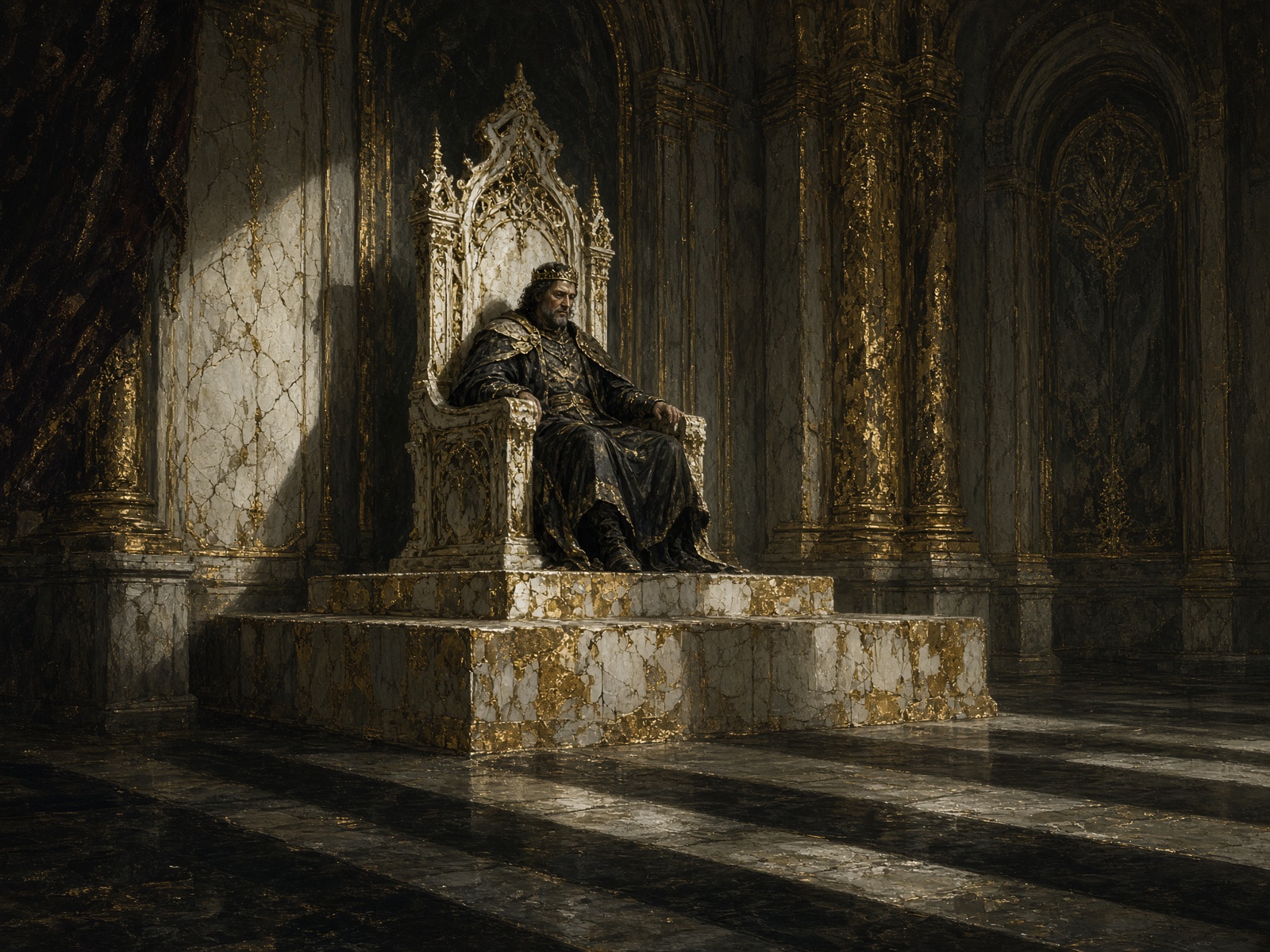
C3. The Throne That Does Not Descend
C3. The Throne That Does Not Descend
- A. The dais — No descent. Sitting is already an ascent.
- B. Althar’s seat among them — He does not take the head. That is a kind of throne.
- C. The looking — Inward Gaze. Do not cut this scene.
Althar does not rise. The throne is a seat on a dais with no steps down — only up, a little, as if even sitting were an ascent. He looks pleased to see you. He looks like a man who has been lonely for forty years and calls it purity. “Prove you are finished,” he says. “Then you may judge me.”
The winning move is rarely a clean beheading. Three resolutions all break the seal if the city’s lie is spoken in this room:
Reckoned: someone important (Althar, Irel, or Sera) admits, in public, that they need help — and the city does not fall off the mountain. The party must be willing to be unfinished too. Althar may live.
Claimed: a PC takes the throne, or the title Completeness offered them at the feast, and keeps it. The city eats. The seal still breaks. Book 8 will remember who sat.
Bloodied: they kill him as a dungeon boss and leave. The seal breaks if the performance ends. Sera or Irel will try to restart it within a season unless the party taught the city how to fail.
Althar will not fight like a beast at first. He asks each PC the feast-question again, with their own words quoted back. Only when someone refuses the proof — or someone takes the crown — does the room become a fight.
At this band (mortal): Althar is a political and ritual threat; if you want a lighter climax, let champions from C2 be the steel and keep him as a social solo. His aura still forbids Aid.
God-King Althar Vael
extreme · 160 XP each
Althar talks while he fights. He offers to erase mistakes as they happen. He targets whoever admitted need at the feast. If reduced to 0, he does not beg — begging would unmake him. He looks confused, like a man who has run out of script. What they do with that look is the last note of the book.
God-King Althar Vael
solo 3
Humanoid, Completeness, Unique
- AC
- 21
- HP
- 54
- Perc
- +12
- Fort
- +9
- Ref
- +6
- Will
- +12
Melee Strike +15, Damage 1d12+8
Ability DC 22
Aura of Completeness (30 feet): creatures cannot Aid; to accept help they must succeed at Will against his DC. When a creature in the aura critically fails an attack or skill, Althar can spend a reaction to make them stand, smiling, as if it did not happen — erasing the failure and 1d4 of their remaining hero points (or 1 Focus Point, or a spell slot of the GM’s choice). He is trying to complete them.
Pride-guard × 3
standard 0
Humanoid, Completeness
- AC
- 15
- HP
- 17
- Perc
- +6
- Fort
- +9
- Ref
- +6
- Will
- +3
Melee Strike +6, Damage 1d6+2
Ability DC 17
Treasure (major): 20 gp plus a permanent item of level 1.
C4. Aftermath
If the city learns to be unfinished, the first public failure should be small and real: a mural left cracked, a feast with an empty plate, Sera missing a lesson on purpose. Play one scene of weather changing. Then leave. Pride does not need a parade.
If they took titles, write them down. Other Courts will address them as such.
Break the Seal of Pride when the central conflict is resolved — not merely when a boss is dead. Mark it on Your Table.
Conclusion
Award the second level-up when the seal breaks (or the listed XP if you track it). Update the party roster to their new levels before you open the next Court — the next book will read whatever you type.
Vaelspire remains on the map. If they return later, the mountain remembers whether they taught it to descend.
How this Court ends
Pick the ending the table actually reached. Victory breaks the Seal of Pride. Defeat and walking away do not. Then update the roster to the new levels.
Echoes to record
- Did the party take a title?
- Who knelt, and to what?
- Is Althar alive?
- Does Vaelspire still forbid failure?
- Which PC was congratulated until they could not tell backbone from ego?
Bible notes for this Court
Working title: The Crown That Would Not Bow
The Court: Vaelspire, a mountain citadel that refuses to weather
Seal: Pride
Suggested length: 4–6 sessions · 2-level module at current APL
The runnable, print-ready module lives in the companion: open Pride after setting Your Table. Every DC, creature, gold piece, and XP award on that page is already filled for the roster (or the preview). This file is the bible brief the module is built from.
Pride is not first because it is simplest. It is first in the binder because it is the sin that disguises itself as backbone.
Core theme
Pride is the belief that you are the exception. Consequence is for other people. Help is for the weak. Apology is a kind of death.
Vaelspire has made that belief into law. No one may fail in public. No one may be lesser. The city’s motto is carved over every gate: We Do Not Descend.
Main conflict
God-King Althar Vael should have died forty years ago. He did not. He had himself declared complete — past error, past counsel, past the need to hear a voice that is not his own. The citadel is locked in a performed golden age. Murals are repainted nightly so the cracks do not show. The granaries are empty and the feasts are still announced.
A quiet resistance — the Lower Choir — has begun singing the old funeral hymns in the cisterns. Althar calls this treason. It is, in fact, grief.
The party arrives as honored guests, because Vaelspire only admits people it can flatter. The flattery is the first trap.
The conflict is not “kill the tyrant.” The conflict is: can anything in this place be allowed to be unfinished — including the player characters?
Althar will offer them crowns, titles, command of a legion that does not exist. He is generous. Pride always is, at first.
How this book forces the characters to look inward
Pride does not accuse the arrogant. It congratulates them until they cannot tell the difference.
Each PC is given a moment in Vaelspire where their competence is treated as destiny. A problem they can solve is inflated into proof that they should never have to listen again. Then the book asks, in public:
What would you still refuse to kneel to, even if kneeling would save everyone else in the room?
The Inward Gaze here is about the hill they would die on — and whether that hill is principle or ego wearing principle’s coat.
A paladin’s code, a wizard’s certainty, a rogue’s “I work alone,” a fighter’s legend: all of these can be Pride. The book must use the actual characters, not a generic king-metaphor.
The Court as a place
Vaelspire is white stone and thin air. Stairs always go up. There are no beggars; they have been renamed “those in training.” Children are ranked. Elders who admit fatigue are sent to the Quiet Balconies, which is a cliff.
At night, the city is silent except for paintbrushes. The muralists are not allowed to stop.
Key faces
- Althar Vael — not a raving villain. Warm, tired, still handsome, absolutely unable to say “I was wrong.” He believes that if he admits a single error, the city will avalanche.
- Canoness Irel — high priest of the state cult of Completeness. She knows the granaries are empty. She will not say it until someone else says it first.
- Tov the Unfinished — leader of the Lower Choir. A former muralist who painted a crack on purpose and was condemned. He is not humble. He is furious that humility was criminalized.
- Princess Sera Vael — the heir who has never been allowed to fail a lesson. She is twenty, brilliant, and hollow. She may be the way in, or the next Althar.
Climax
The party will stand in the Throne That Does Not Descend. Althar will not fight like a beast. He will demand they prove they are worthy to judge him — which means proving they have never needed anyone.
The winning move is rarely a clean beheading. The winning move is making the city survive an admission. If Althar falls without the city learning how to be unfinished, Sera or Irel will simply continue the performance.
Echoes to record
- Did the party take a title?
- Who knelt, and to what?
- Is Althar alive?
- Does Vaelspire still forbid failure?
Book 8 will ask whether the PCs’ own refusals to kneel were any different from his.
Scaling
Do not edit frozen numbers into this brief. The companion generates them.
- Mortal (APL 1–4): Althar is a political and ritual threat; his champions do the violence.
- Champion (5–10): Althar himself takes the field as a mythic champion whose aura forbids allies from aiding one another.
- Mythic (11–16): the citadel itself enforces Completeness — magic that unmakes anyone who admits need.
- Master (17–20): the throne room is already Book 8’s weather.
After this book, update the roster to the new levels and open any remaining Court.