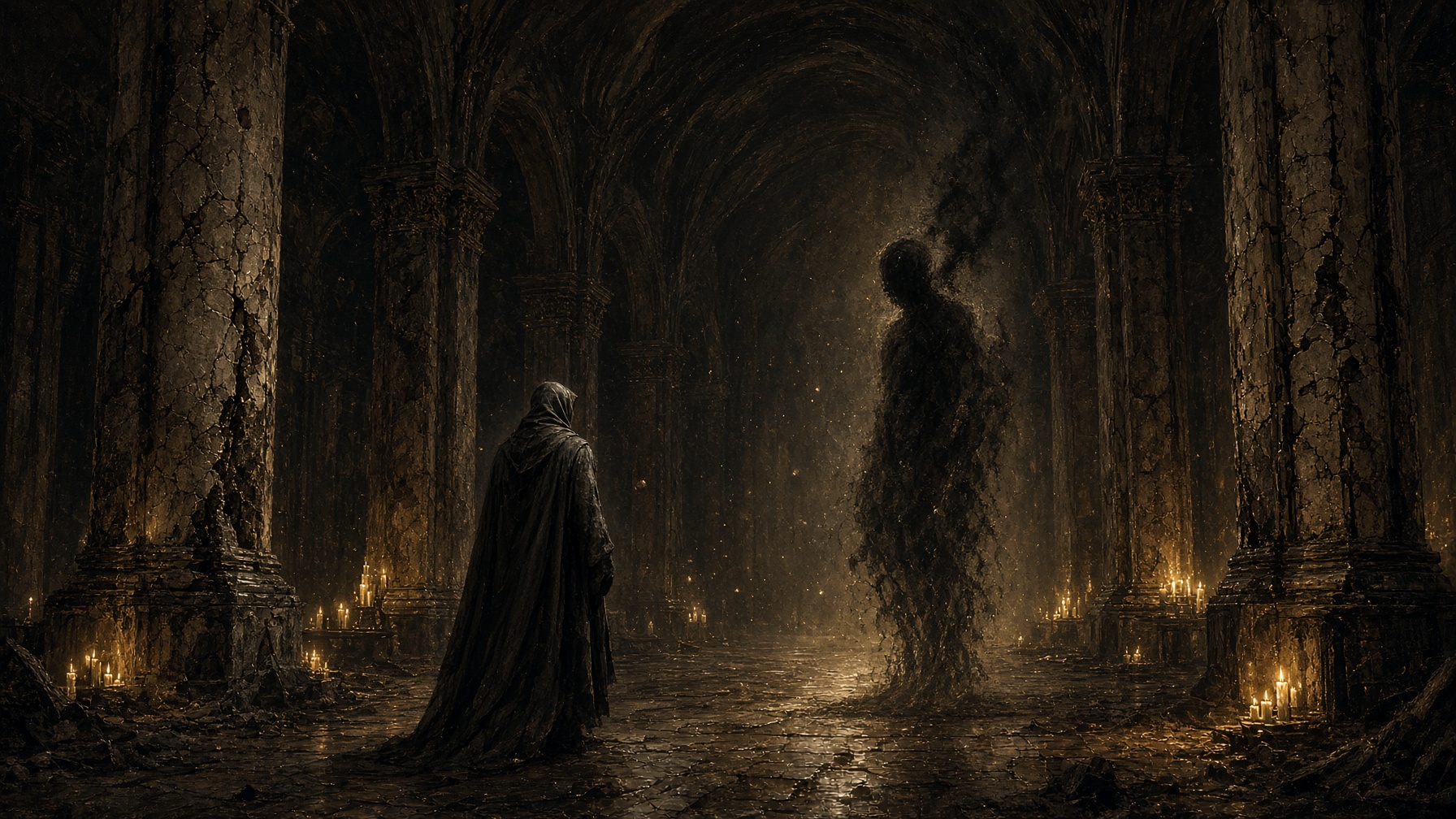
A Pathfinder campaign in eight books
Sins of the Mirror
There are no literal mirrors here. Before every major decision, each character must look inward and confront what they actually are.
Your table
Party
You do not need a party yet. Set a preview size and level to see every book fill in. When the real table exists, add the characters — DCs, creatures, XP, and treasure rebuild from that roster.
Running at 4 × APL 1 (preview).
Open a Court
Books 1–7 in any order. Each one is a 2-level module at the APL above. Right now that is levels 1–3. Book 8 stays sealed until seven Courts are finished. Each book is a full printable module: maps, faces, scaled encounters, and victory or defeat.
- Book IFull module
Pride
The Crown That Would Not Bow
A citadel that forbids failure. Pride congratulates you until you can no longer tell backbone from ego.
Vaelspire · levels 1–3
- Book IIFull module
Greed
The Ledger of Hollow Coins
A republic where years and names are for sale. Wanting becomes the only way to know you are still here.
Goldwake · levels 1–3
- Book IIIFull module
Lust
The Garden of Unkept Vows
A festival that forgot how to end. The hunger is not flesh — it is to be completed by someone else.
Thornveil · levels 1–3
- Book IVFull module
Envy
The City of Borrowed Lives
Twin cities that steal what they cannot stand to watch. Fairness as a mask for the wound of comparison.
Narth · levels 1–3
- Book VFull module
Gluttony
The Feast That Would Not End
A breadbasket turning into a mouth. Consumption without nourishment — and the skill of enough.
Marrowfen · levels 1–3
- Book VIFull module
Wrath
The War That Remembers Every Slight
A feud so old the crime is lost. Anger as identity, and the question of who you are without it.
Cinderreach · levels 1–3
- Book VIIFull module
Sloth
The Kingdom That Would Not Wake
Not laziness — the refusal to care, because trying might fail or might matter.
Duskhaven · levels 1–3
- Book VIII
The Master of Sins
The Name You Will Not Speak
Locked until all seven seals are broken. The Master is not a devil. They are the ending of looking inward.
The Unwritten Court · locked
Sins of the Mirror is a dark, psychological Pathfinder campaign told in eight books. It is not a story about glass, reflections, or magic mirrors. It is a story about the moment a person stops performing virtue and has to live with what is left.
The party are not chosen because they are heroes. They are chosen because each of them already carries a crack they have not named.
The eight-book structure
| Book | Sin | Working title | The Court |
|---|---|---|---|
| 1 | Pride | The Crown That Would Not Bow | Vaelspire |
| 2 | Greed | The Ledger of Hollow Coins | Goldwake |
| 3 | Lust | The Garden of Unkept Vows | Thornveil |
| 4 | Envy | The City of Borrowed Lives | Narth |
| 5 | Gluttony | The Feast That Would Not End | Marrowfen |
| 6 | Wrath | The War That Remembers Every Slight | Cinderreach |
| 7 | Sloth | The Kingdom That Would Not Wake | Duskhaven |
| 8 | — | The Name You Will Not Speak | The Unwritten Court |
Books 1–7 are peer stories, not a ladder. Book 8 is the only locked chapter.
The any-order rule (Books 1–7)
The Seven Courts are real places on the continent of Aureline. They opened at the same hour. None of them is “the first sin.” None of them is the hardest by design.
The party may walk the Courts in any sequence they choose.
- There is no intended order.
- There is no secret correct order.
- The world does not punish them for choosing “wrong.”
- The world remembers the order they chose.
This is the campaign’s spine. Players feel authorship. The GM never railroads them toward Pride because it is Book 1 in the binder.
Each Court has scaling notes so the same story can be run for a 1st-level company or a 15th-level one. Threat changes. The moral engine does not.
You do not need a party yet. Set a preview size and level on Your Table. When the real characters exist, type their count, levels, and classes — the open book rebuilds DCs, creatures, XP, and treasure. After a Court, update the roster and pick the next one. Pride is the first full printable module; the rest follow the same template.
The lock on Book 8
Book 8 — The Master of Sins — cannot begin until the party has completed all seven previous books.
This is not a GM preference. It is a law of the setting.
The Master will not face anyone who has not first faced themselves in every register. The Unwritten Court has no road until seven seals are broken. Attempts to scry it, teleport to it, or bargain a shortcut fail in ways that feel like the world politely declining.
When the seventh seal breaks, the eighth door is not a reward. It is an appointment the party can no longer postpone.
What “complete” means
A book is complete when the Court’s central conflict has been resolved — not when a boss is dead.
Resolution can mean:
- the Court is broken, healed, or claimed
- the ruling power is overthrown, converted, or left standing on purpose
- the party has answered that book’s Inward Gaze (see Custom Mechanics)
A Court left half-finished does not break its seal. The Master is patient. The land is not.
Tone
Darker, moral, introspective. Violence has weight. Humor, when it appears, is dry and expensive.
Do not play this as torture-tourism or as a sermon. The sins are human. Every antagonist has a reason that would make sense at 2 a.m. The party will sometimes agree with them.
The question is never “are we good?” The question is “what will we still refuse to see?”
The campaign promise to the table
By the end of seven books, every player character will have been asked — in front of the people who travel with them — to name the thing they do not want to be. Book 8 uses those answers.
If a table wants dungeon crawls with a sin theme pasted on, this is the wrong campaign. If a table wants to find out who their characters actually are, this is the door.