SotM-5 · Pathfinder 2e
The Feast That Would Not End
Book 5 of Sins of the Mirror — Gluttony
4–6 sessions · 2-level module at current APL
 123
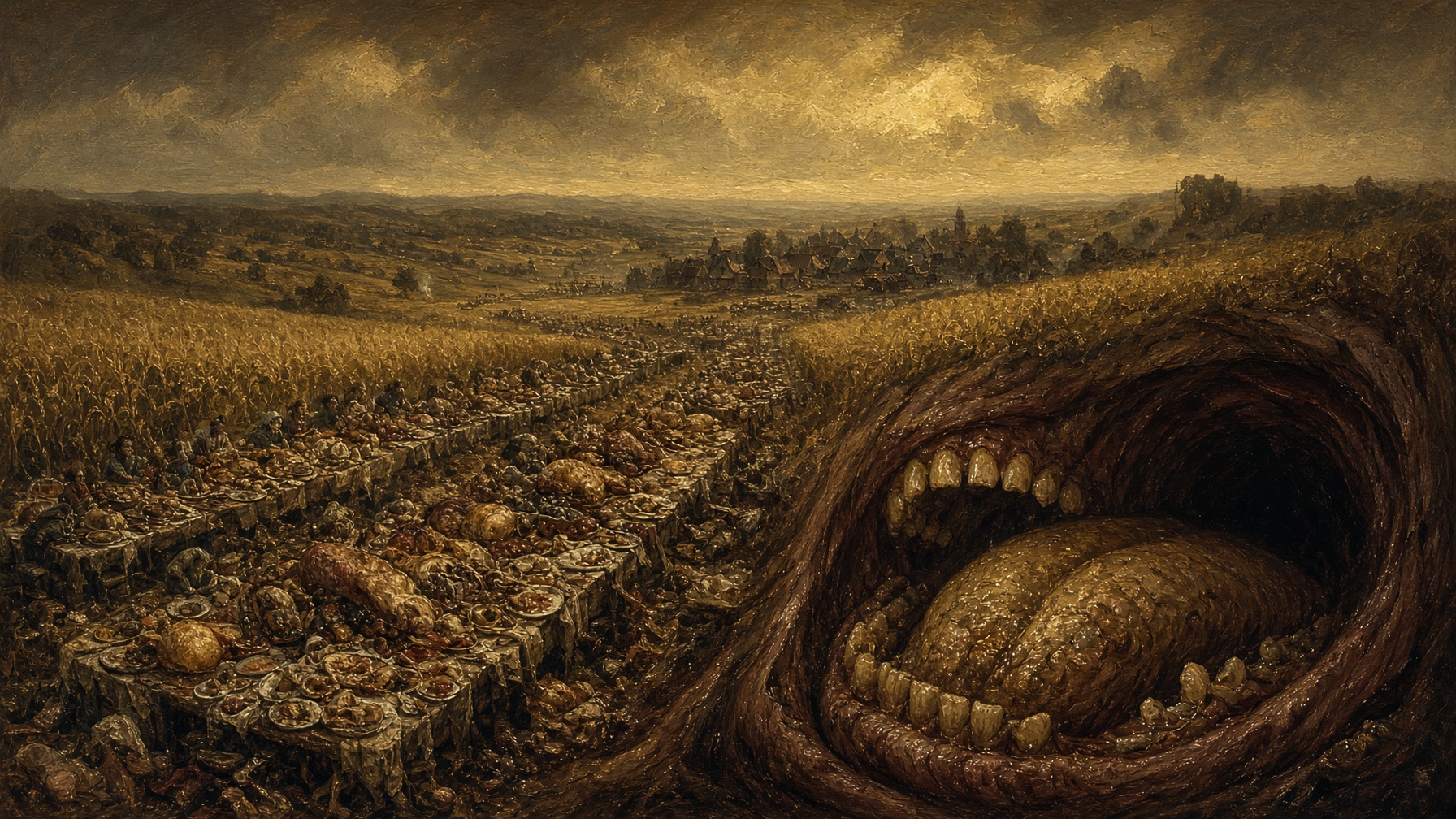
123Marrowfen, the mouth
- 1. The standing feast (A1) — Imri’s question.
- 2. Honest strip (B1) — Names come back.
- 3. Great Service (C2) — The Blessing.
Adventure background
Marrowfen was a breadbasket. It is becoming a mouth. The Blessing in the soil heals fields too fast. Plates refill. Names get loud. Hollowhearth keeps the fields shouting so famine cannot think.
Gluttony here is not fat jokes. It is taking past hunger — consumption without nourishment — and the skill of enough.
Faces of the Court
Show these at the table. The Court has faces; use them.

The honest question
Cook Imri
Wants. For hunger to mean something again.
Lever. She will feed them. She will not forgive them for not tasting it.

Memory of famine
Reeve Padra
Wants. Never empty years again, even if the years are too full.
Lever. She is not a villain. Argue with the fear, not the office.

Theory of enough
Senn of the Fasting Choir
Wants. To starve the Blessing before it finishes the world.
Lever. They will listen to a stop that is not a famine.
Synopsis
They are fed until they cannot stand, then asked what else they want. Cook Imri still asks if they are hungry, and means it. Reeve Padra remembers empty years and will not risk them. The Fasting Choir wants the Blessing starved. The Board of Plenty wants it worshipped.
The Great Service will fuel the Blessing with a village, a returned famine, or a PC’s defining hunger — unless someone teaches it enough.
Getting started
Run this book at the APL and player count on Your Table. Every DC, creature, gold piece, and XP award on this page is already filled for that table.
Suggested pacing: level once in the middle of Part 2 and once when the seal breaks. Listed XP is Pathfinder 2e per-PC encounter XP (a moderate fight is 80 XP each, not divided).
Do not skip the Inward Gaze at the climax. If you are short on time, cut a fight, not the looking.
Do not make fat jokes. Gluttony here is taking past hunger. Play the feast as genuine hospitality. The bill starts after enough.
Treasure this book (~2 levels): 110 gp for the table
Permanent items: one item of level 1, one of level 1, 4 consumables of level 1
A
Part 1: Second course
Hospitality with a bill. Blight that will not stay dead.
A1. The table that is never cleared
The feast is already in progress when you arrive, which is a lie: it has been in progress since spring. A cook with flour on her mouth asks, as if it were a real question, whether you are hungry.
Hospitality is genuine. The bill is later. Do not punish them for eating. Gluttony starts after enough.
- DC 15 (standard) — Survival or Medicine to notice nourishment is missing from the plenty
Blight-beasts in the grain
low · 60 XP each
Too many. Too calm. The field is not angry. It is hungry on their behalf.
Blight-calf
standard 1
Animal, Blessing
- AC
- 17
- HP
- 23
- Perc
- +7
- Fort
- +10
- Ref
- +7
- Will
- +4
Melee Strike +9, Damage 1d8+4
Ability DC 17
Stands back up unless someone accepts ‘enough’ and spends an action not attacking.
Grain-swarm × 4
minion -1
Swarm, Minion
- AC
- 12
- HP
- 4
- Perc
- +5
- Fort
- +5
- Ref
- +8
- Will
- +2
Melee Strike +6, Damage 1d4+1
Ability DC 17
Treasure (minor): 6 gp.
A2. Imri’s question
Imri will not help until someone answers. She is not a quest-giver with a marker. She is a cook who has watched people eat her food and not taste it for three harvests.
Let the table sit with the question. If they joke it away, she feeds them anyway and does not go to C2 with them. If they name a true taking — loot, attention, revenge, the need to finish the plate — she will stand in the kitchen-shrine later and say “enough” when they cannot.
Write the answer down. The Blessing will quote it. Do not invent a hunger the player did not offer.
A3. Padra’s empty years
The reeve is not a fool. She remembers famine. She will not gamble the Blessing on philosophy. She will hire the party to stop the Fasting Choir.
B
Part 2: The honest edge
Where nothing grows, names come back.
B1. The strip where nothing grows
A band of honest dirt. People who walk it remember their names. The Blessing hates it.
- DC 17 (hard) — Nature or Religion to keep the strip from being ‘healed’ overnight
B2. Fasting Choir
They are willing to kill for a theory of enough. Their leader, Senn, is not cruel. They are terrified of a second course that never ends.
Board of Plenty versus Choir
moderate · 80 XP each
Both sides want the party as proof. Stopping the fight by leaving food on the table is a valid win.
Plenty-guard × 2
standard 1
Humanoid
- AC
- 17
- HP
- 23
- Perc
- +7
- Fort
- +10
- Ref
- +7
- Will
- +4
Melee Strike +9, Damage 1d8+4
Ability DC 17
Fasting blade × 2
standard 1
Humanoid
- AC
- 17
- HP
- 23
- Perc
- +7
- Fort
- +7
- Ref
- +10
- Will
- +4
Melee Strike +9, Damage 1d8+4
Ability DC 17
Treasure (standard): 14 gp.
B3. The land that heals too fast
The field was a battle yesterday. This morning it is a garden. The dead are presentable. Flowers have come up through a ribcage as if invited. The Blessing is proud of its work.
This fight has a second win condition: leave a scar. If they reduce the Blessing-shape to 0 without anyone declining a second helping, the land heals by the next scene and both the Choir and the Board call it proof.
Declining is mechanical: a PC spends an action they could have used to Strike, loot, or cast on a dead fight, and says they are finished. Teach this here. C2 is the same clock, louder.
At this band (mortal): Beasts and policy.
A battlefield that will not scar
severe · 120 XP each
The win condition is enough, not zero HP. Describe it.
Blessing-shape
elite 2
Beast, Blessing
- AC
- 19
- HP
- 40
- Perc
- +11
- Fort
- +11
- Ref
- +8
- Will
- +5
Melee Strike +13, Damage 1d12+6
Ability DC 20
Regenerate unless a creature in the fight has declined a second action, spare, or loot this scene.
Refilled dead × 4
minion -1
Undead, Minion
- AC
- 12
- HP
- 4
- Perc
- +5
- Fort
- +8
- Ref
- +5
- Will
- +2
Melee Strike +6, Damage 1d4+1
Ability DC 17
C
Part 3: The Great Service
Fuel the Blessing, return famine, or teach it enough.
C1. The menu
A village, a returned famine, or a PC’s defining hunger. Those are the courses the Board has written.
Show the village. Name three people the party has already eaten beside. Do not let “a village” stay a statistic.
Padra will vote for the hunger of a PC over famine. Senn will vote for famine over a village. Imri will not vote. She will ask if they are still hungry.
C2. Enough
C2. The Great Service
- A. The table — Second helpings are the clock.
- B. The kitchen-shrine — Imri will stand here if they let her.
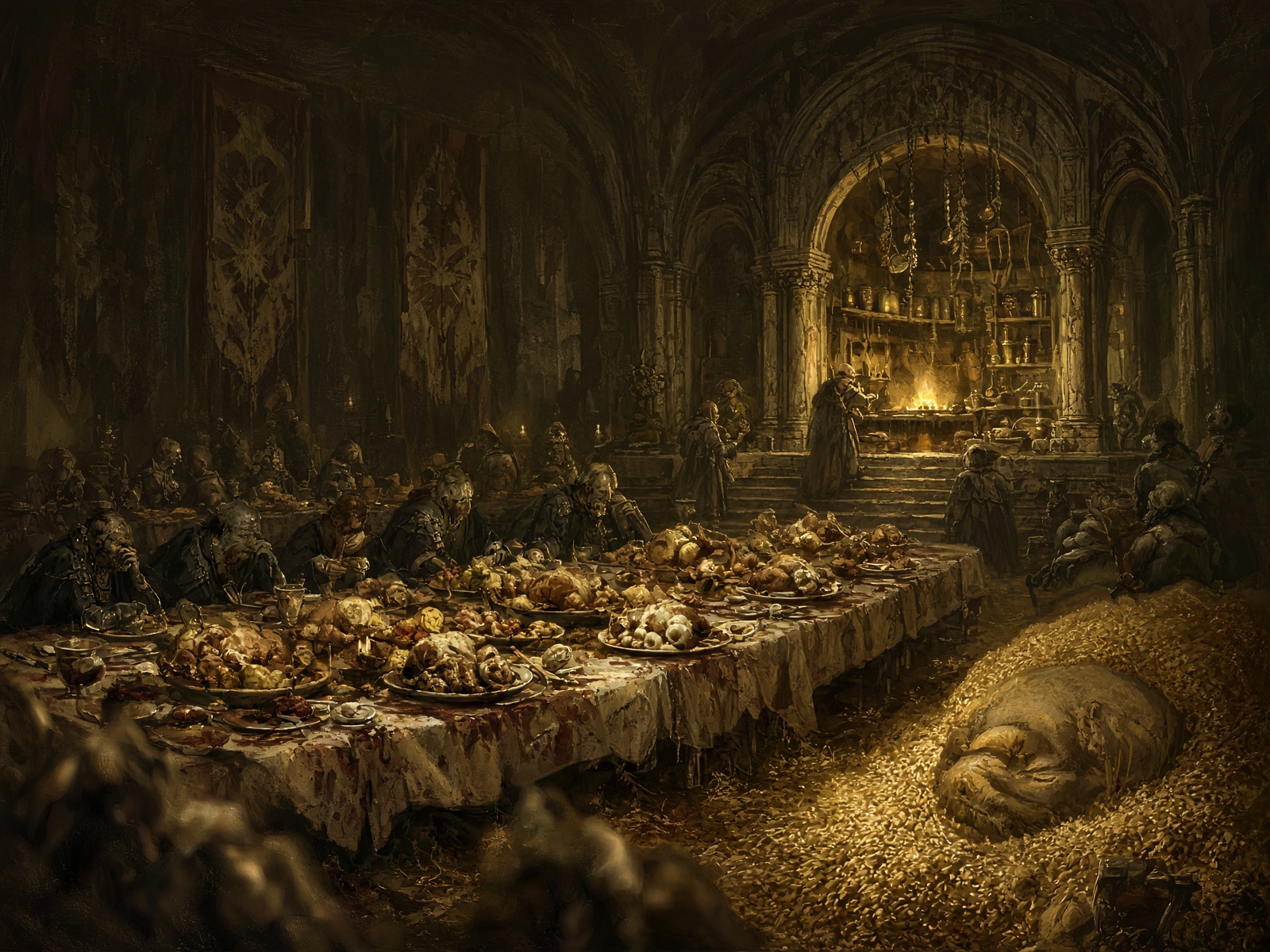
The Great Service is a table the length of a street. Courses arrive already praised. The Board has written three possible fuels on the menu. Imri, if she is here, has her hands in the dough and will not look up until someone stops.
The three courses: a village (named, mapped, people the party has met), a returned famine in a Court they already saved, or a PC’s defining hunger from A2. The Board prefers the village. Padra prefers anything but famine. Senn prefers famine to a second course that never ends.
The Blessing does not die while any creature takes a second helping. Track the clock openly. Enough is something the players can see.
Claimed: they become a mouth. Once per day, after they stop, temporary Hit Points equal to twice level — and Book 8 will offer another course. Reckoned: a strip of honest dirt remains. Padra will hate the risk. Mean that too.
At this band (mortal): A table and a theory. Second helpings are the clock.
The Blessing, wearing leftover hunger
extreme · 160 XP each
Killing it risks starving other Courts. Teaching it enough leaves a strip of honest dirt and a cook who still asks.
The Blessing
solo 3
Unique, Blessing
- AC
- 21
- HP
- 54
- Perc
- +12
- Fort
- +12
- Ref
- +9
- Will
- +6
Melee Strike +15, Damage 1d12+8
Ability DC 22
Does not die while any creature in the fight takes a second helping (a second Strike on a downed foe, extra loot, an extra spell on a dead fight). Enough is a mechanical clock.
Course × 3
standard 1
Beast
- AC
- 17
- HP
- 23
- Perc
- +7
- Fort
- +10
- Ref
- +7
- Will
- +4
Melee Strike +9, Damage 1d8+4
Ability DC 17
Treasure (major): 20 gp plus a permanent item of level 1.
Conclusion
If they Claimed, they have the Gluttony boon: once per day, after they stop, gain temp HP equal to twice level. Book 8 will offer another course.
How this Court ends
Pick the ending the table actually reached. Victory breaks the Seal of Gluttony. Defeat and walking away do not. Then update the roster to the new levels.
Echoes to record
- What did they take past hunger?
- Is Imri still asking?
- Did famine return anywhere?
- Who learned enough?
Bible notes for this Court
Working title: The Feast That Would Not End
The Court: Marrowfen, a breadbasket turning into a mouth
Seal: Gluttony
Suggested length: 4–6 sessions
Gluttony is consumption without nourishment. It is not only food. It is the appetite that does not have an off switch: experience, violence, knowledge, control, more campaign, more proof, more.
Core theme
Enough is a skill. Marrowfen has forgotten it. The harvest never stops. Tables are never cleared. The land has learned to eat, and it is better at it than the people are.
Main conflict
Once, Marrowfen fed half of Aureline. Then a harvest-god’s dying blessing was misunderstood as a command: never hunger again. The fields answered too well. Grain grows in a night. Meat does not end. The surplus had to go somewhere.
It went into people, first — fat years, festivals, kindness. Then into the ground. Then the ground began to take people back.
The Board of Plenty, a council of landowners, insists the solution is more production. The Fasting Choir insists the solution is to stop eating until the land is ashamed. Both are wrong in ways that will kill someone.
At the center is Hollowhearth, a mill-town that has started serving “the second course”: those who cannot stop, cooked into the blessing so the fields stay loud.
The conflict: what appetite in the party has no off switch — and what will they refuse to consume even if the land (or the campaign, or victory) starves without it?
How this book forces the characters to look inward
Put abundance in front of them until it becomes horror, then put scarcity in front of them and see whether they hoard.
Gluttony in an adventuring party often looks like: finishing every enemy, taking every room, opening every chest, burning every resource “because we might need it,” refusing to leave a dungeon. This book names that pattern without sneering at play.
The Inward Gaze:
What do you take past the point of hunger? What would you have to feel if you stopped?
Stopping is the mechanic. Stopping is the shame. Stopping is the victory condition more often than killing the god.
The Court as a place
Wet black soil, gold grain, flies, music from banquet-halls that never empty. The smell is wonderful and then it is not. Rivers run thick. Animals are too many and too calm.
At the edge of the fen, nothing grows. A clean, honest hunger. People who walk there remember their own names.
Key faces
- Reeve Padra — believes a full table is the only moral good. Will feed the party until they cannot stand. Not a fool. She remembers famine.
- Brother Kell of the Fast — wants the blessing inverted. His choir is dying of purpose. He envies (yes) the Board’s certainty.
- Cook Imri — the only person who still asks “are you actually hungry?” before serving. Knows how Hollowhearth’s second course is made. Has not run. That is either courage or appetite for guilt.
- The Blessing — not a monster at first. A warmth in the soil. When it finally takes a shape, it looks like whatever the party could not leave on the plate.
Climax
A Great Service is prepared: the feeding of the Blessing with a choice of fuel — a village, a memory of famine (which would return famine), or a PC’s defining hunger (their drive, their rage, their need to save everyone).
The party can kill the Blessing (and risk famine across Aureline), bind it to a cycle of enough, or take it into themselves and become the new off-switch — a costly, intimate ending.
Echoes to record
- Did the party eat of the second course, knowingly or not?
- Who learned to stop?
- Is Marrowfen still feeding the other Courts?
- What hunger did a PC name?
Scaling
Low: blight-beasts, poisoned hospitality, moral resource-management. Mid: the land as a battlefield that heals too fast; enemies that stand back up unless the party accepts “enough.” High: consumption as a world-rule; hits restore the enemy unless a PC forgoes a resource they love.